Explanations of Social Class Differences in Educational Achievement
Part List
Introduction - Click Here
Part 1: Explaining Social Class Differences in Educational Achievement: IQ Theories - Click Here
Part 2: Sociological Explanations of Social Class Differences in Educational Achievement: Cultural Deprivation - Click Here
Part 3: Sociological Explanations of Social Class Differences in Educational Achievement: Cultural Difference - Click Here
Part 4: Sociological Explanations of Social Class Differences in Educational Achievement: Material Economic Differences
Part 5: Sociological Explanations of Social Class Differences in Educational Achievement. Some More Recent Studies - Click Here
Part 4:
Sociological Explanations of Social Class Differences in Educational Achievement: Material Economic Differences
I can remember a conversation in the1970s with an elderly gentleman who told me that he had passed the Grammar school entrance examination in the early 20th Century but had been unable to take up his place because his parents could not afford the associated traveling and uniform costs. Indeed neither could they afford the requisite new pair of shoes for him. Such cases were far from uncommon and it has been argued persuasively that working class education opportunities have always been restricted by economic inequality and poverty and that this continues to be the case even in the early 21st Century.
The effects of economic disadvantage on educational attainment are often measured via the comparison of the examination results of pupils eligible and ineligible for Free School Meals [FSM]
However, click here for a more technical article which indicates that Free School Meal eligibility data must be interpreted with care. Changes in FSM eligibility criteria resulting n increased FSM eligibility mean that when we compare the attainments of FSM eligible pupils in different years we are not comparing like with like.
Click here or more recent data on Free School Meal Eligibility and Attainment at GCSE Level
It is generally agreed that the GCSE Attainment gap as between pupils eligible and ineligible for free school meals was narrowing slowly in the early years of the 21st Century but that the particularly adverse effects of COVID on pupils eligible for free school meals more than offset the earlier years improvement.
Click here and scroll down to Parts Eleven and twelve for more detailed information on the effects of Covid on pupils eligible for free school meals. Click here for a summary of the Education Select Committee Report on the National Tutoring Programme and Click here for BBC coverage of the Report: ” Covid pandemic fuels deepening education inequalities in England, say MPs” [BBC March 11th 2022.]
Table : Gender, Free School Meal Eligibility and Percentages of Pupils gaining 5 or more GCSE A*-C Grades including English and Mathematics 2008/9 – 2012/13 [Source : DFE SFR 2011/2012 and DFE SFR 2012/13 GCSE Attainment and Pupil Characteristics: ]
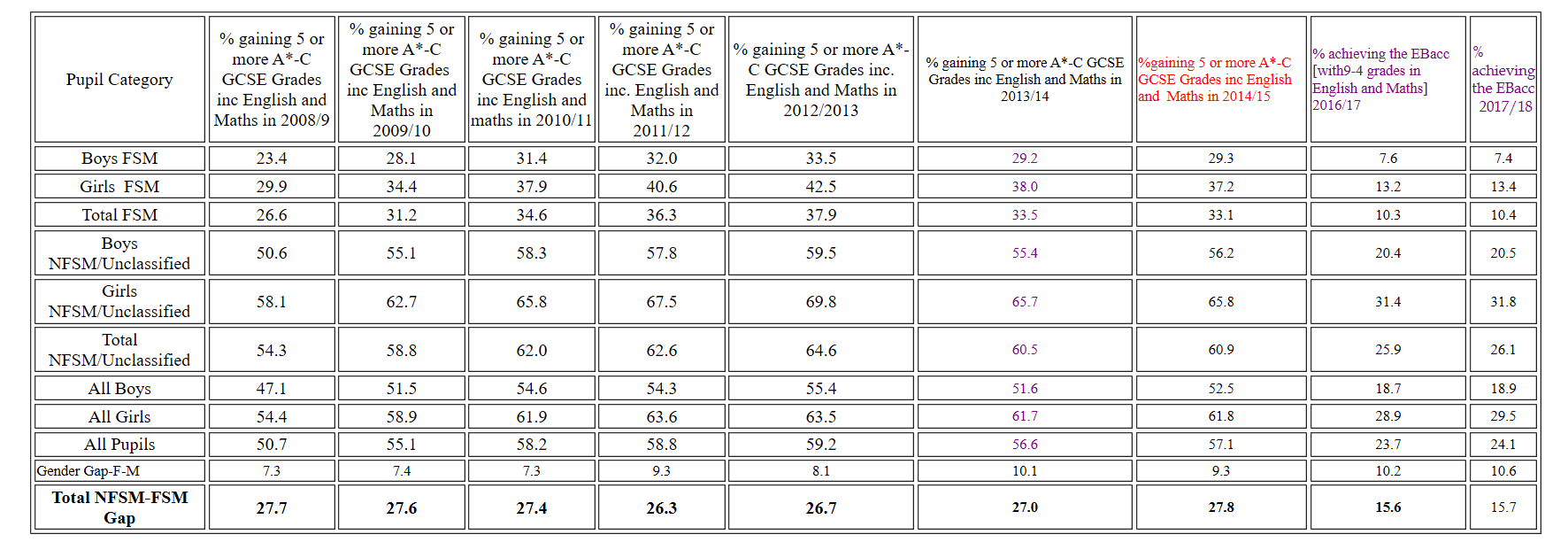
The above table gives an indication of the differences in educational achievement at GGCSE level of pupils eligible and ineligible for free school meals in the earlier stages of the 21st Century but you may click here for more comprehensive data for the years 2018/19 – 2023/24 and you may use the links on that page to update the data in future years.. You may click here for differences in educational achievement between pupils eligible and ineligible for free school meals at GCSE Level between 2019/20 and 2024/25. As is indicated in this recent [2024] Guardian article , poverty also has adverse effects on the educational achievements of poor higher ability children
Eligibility for free school meals is generally regarded as a reasonable but far from perfect indicator or relative poverty. The data point to significant education achievement gaps at all levels between students eligible and ineligible for free school meals but the relative educational underachievement of pupils eligible for free school meals may be explained by a combination of sociocultural and economic factors. In Part Three of these notes I have suggested that theories of working class cultural deprivation are open to significant criticism but that it is entirely possible that the educational prospects of working class pupils [ and especially those eligible for on free school meals] may be impeded because although their parents may be keen for their children to succeed, their limited social cultural and economic capital {see Bourdieu] may prevent them from providing the positive practical help necessary to ensure educational success , whereas in the case of many middle class parents , the reverse is true. Further problems may well arise because FSM-eligible pupils are more likely to live in deprived neighbourhoods and to attend poorly performing schools.
Adverse economic circumstances may affect the educational prospects of working-class children [and especially FSN=eligible children] n several ways as is indicated in the following list but recent research from the Education Policy Institute on FSM -eligible pupils indicates that these children may also ace a range of socio-cultural disadvantages.
Adverse economic circumstances may affect the educational prospects of working-class children in the following ways.
- Working class babies are more likely to be born with a low birth weight and to develop more slowly in the pre-school early years of their lives.
- There may be fewer preschool play groups or nurseries in working class areas.
- The educational development of some working-class children may suffer as a result of under- nourishment, sickness, tiredness and absence. In some cases, they may be forced into school absence to look after sick siblings because mothers are in paid employment but are unable to afford to take time off work.
- Some working-class children may live in dilapidated housing and may not have their own rooms for quiet study.
- Their parents may be unable to afford useful books, educational trips and personal computers.
- The findings of D. Finn (1984) showed that children from poor families were likely to have less time available for their studies because they were involved in child labour of various kinds. such as baby-sitting, shop work, paper rounds, warehousing etc and also that working class children, especially working-class girls were especially likely to be involved in housework, a factor which apparently encouraged them to leave school early in the hope of raising their status within the family so as to avoid housework.
- Although many 5th and 6th formers of all social classes nowadays undertake some paid work this work may be more likely to interfere with the studies of working-class students than of middle-class students who may be able to discontinue work well before important examinations and so on. Click here for a recent [March 2015] Observer report showing that taking part-time jobs can undermine pupils’ GCSE attainment levels.
- In “Origins and Destinations” [1980], Heath, Halsey and Ridge pointed to the cost of supporting students between the ages of 16-18 when no maintenance grants were available as one of the major obstacles to equality of opportunity in Britain. At the time of writing this was considered to a problem especially for girls because it seemed probable that families who were in financial difficulties might give sons rather than daughters priority when it came to the financing of post- compulsory education. Despite the advance of educational opportunities for females, this point may still be relevant in some traditionally minded working-class households. However limited maintenance grants for 16–18-year-olds have subsequently been provided and may well have encouraged more working-class pupils to remain in education beyond the age of 16.
- Some working-class parents may be able to afford a little private tuition for their children, but few can afford to opt for full time private education. It has also become increasingly clear that an increasing number of richer middle and upper class parents are likely to use their economic capital to purchase houses in the catchment areas of relatively successful and popular middle and secondary schools in the State education sector thus enhancing their children’s educational prospects relative to those of working class children who are more likely as a result to be taught in less successful schools.
Our conclusion must surely be that the combined effects of factors 1-9 are likely to result in considerable difficulties for many poor children and that even “comfortably off” working class families face economic difficulties relative to middle- and upper-class families which may affect adversely the educational prospects of children from relatively comfortable working-class backgrounds.
For further information on the potential disadvantages faced by FSM- eligible children Click here and see pages 8-11 of Education Policy Institute Report [2025]on Children registered for FSM and not registered but eligible for FSM.
.
| Activity:
Imagine three families A, B and C, each with two teenage children aged 13 and 15. In family A the husband is an unskilled worker who is usually in full-time employment but occasionally unemployed and the wife is a part-time shop assistant; in family B the husband is in full-time employment as a plumber and the wife is in full- time employment as a secretary; in family C the husband is in full-time employment as a teacher and the wife is in full-time employment as a lawyer |
- Would you necessarily expect the parents in Family A to be fatalistic, lacking in ambition and with a strong present orientation? If they were, how might this be explained?
- On average, although not in every case, the children in Family A would be relatively unlikely to be successful in education. Give three possible reasons for this.
- Give three possible reasons why the children of Family C might be more successful in education than the children in Family B.
Appendix: Covid, Poverty, Free School Meal Eligibility and Educational Achievement
Click here and follow the relevant links to see differences in educational achievement as between pupils eligible and ineligible for free schools 2018/19- 2023/24
Click here for a critical assessment of recent Social Security policies [John Harris: Guardian June 1st, 2022
Click here for numbers eligible for FSM
In recent years the numbers of pupils eligible for free school meals has increased and this was particularly the case during the COVID 10 Pandemic. Traditionally pupils have been eligible for free school meals in term time only and this was initially the case during the pandemic but because of political pressure from various charities spearheaded by Mr Marcus Rashford the UK government agreed to extend free school meals eligibility to the school summer holidays. [ Click here for further details]
Since many pupils eligible for free school meals were absent from school during lock down and at other times during the pandemic it was necessary to make special arrangements for the delivery of free school meals. Thus, schools might arrange for the delivery of free school meals to pupils’ homes; pupils who were staying at home might in some cases return to school to eat their free school meals or o pick up packed lunches; parents might be provided with vouchers [ worth £15 per week] to purchase food for their children from supermarkets participating in the vouchers scheme.
However it was shown that especially in the early stages of the pandemic many pupils who were eligible for free school meals did not in fact receive them; it was argued that it was dangerous for pupils to return to school to receive their free school meals and for parents to visit the schools to pick up free school meals for their children; and it was argued that although the Government’s preferred option was for pupils to receive pack lunches rather than vouchers the quality of the pack lunches received was unsatisfactory and it was suggested that some companies were profiting excessively from their involvement in the scheme. Due to this adverse criticism [ in which Mr Marcus Rashford again played a significant role] the Government agreed to prioritise the increased use of the voucher system and also to monitor the quality of delivered free school meals more carefully.
Click here for the involvement of Marcus Rashford in the successful campaign to make free school meals available during the Summer Holidays of 2020
Click here and here for discussion of the inadequacy of food parcels provided as free school meals as a result of which the Department for Education dropped its “food parcel first” policy.
Click here for a BBC item providing general information on the availability of free school meals during lockdown and on provision during the Summer of 2021
Click here for claims that the government scheme designed to provide for free school meals during the Summer of 2021 was in fact inadequate.
Click here for a BBC documentary on Marcus Rashford
Click here and scroll to pages 33=43 for a Parliamentary Research Briefing on School Meals during The Coronavirus Pandemic
Part 5: Sociological Explanations of Social Class Differences in Educational Achievement. Some More Recent Studies - Click Here
To Return to Introduction and Links Page - Click Here
Or Follow Main Menu for other Information